 Mobile Computing Today News from the Mobile World

Meta’s latest frontier AI models introduce Active Memory, Active Focus and advanced coding capabilities as the company expands its push into personal AI agents.
October 15, 2026 – Meta Platforms has introduced two new frontier artificial intelligence models, Muse Wonder and Muse Wonder Full, marking a major development in the company’s efforts to compete with OpenAI, Google and Anthropic in the rapidly expanding advanced AI market.
Announced on October 12, 2026, the Muse Wonder series represents Meta’s most capable AI models to date. The new systems are designed to perform complex personal and professional tasks, including software development, financial analysis, document interpretation and multi-step problem-solving.
The announcement reflects Meta’s growing focus on developing AI agents that can move beyond generating answers to completing tasks, maintaining context and helping users achieve specific goals.
According to Meta, Muse Wonder is available through the Meta Model API and Muse Code, while Muse Wonder Full is available to Muse Code subscribers.
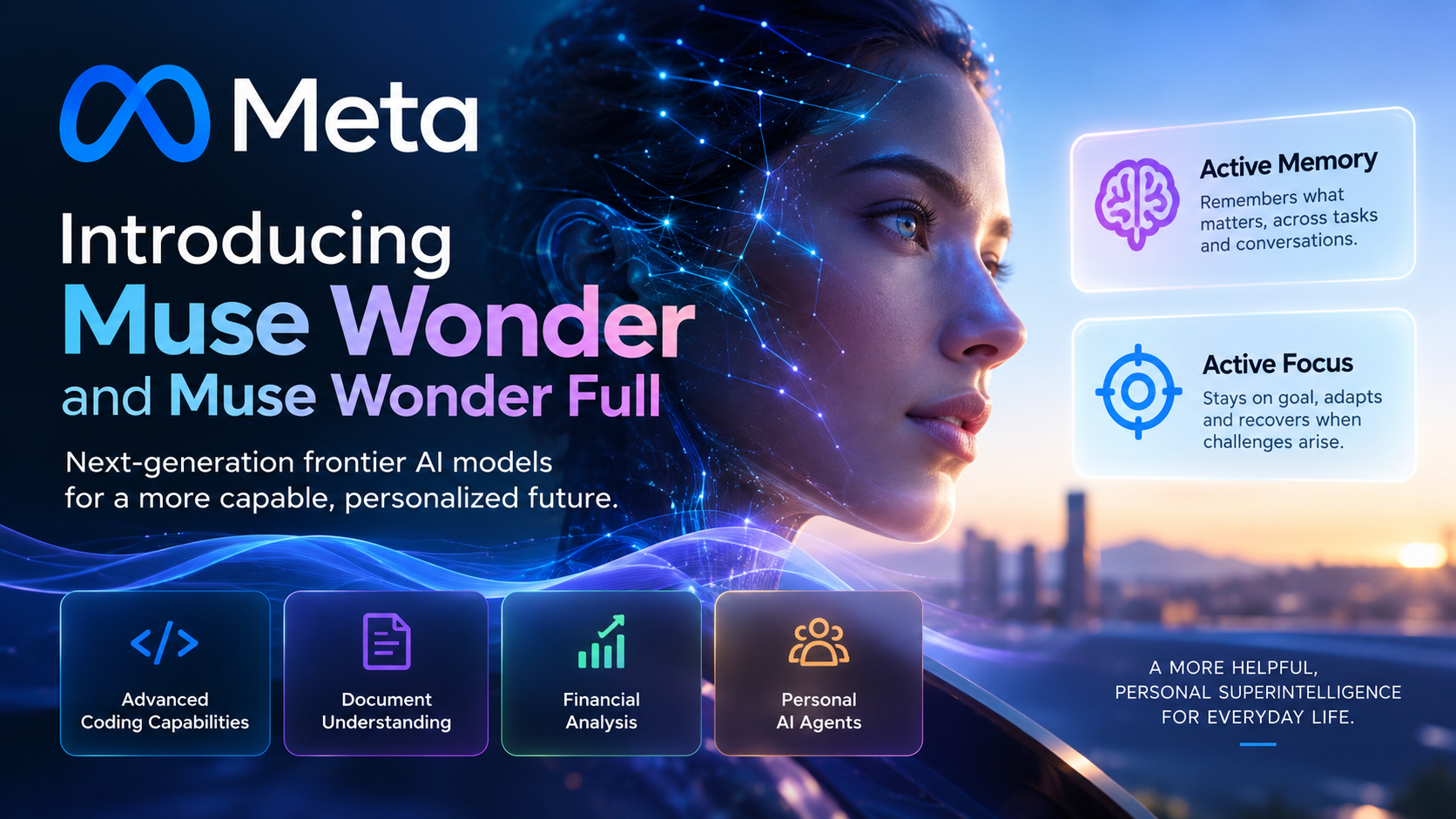
Meta Expands Its Frontier AI Strategy With Muse Wonder Models
The introduction of Muse Wonder and Muse Wonder Full represents an important step in Meta’s long-term artificial intelligence strategy.
The company has invested heavily in AI research, computing infrastructure and engineering talent as it works to strengthen its position against established frontier model developers.
The new models build on Meta’s earlier Muse Spark family, which helped establish the foundation for more advanced AI-powered assistants.
Unlike AI systems primarily designed for short conversations, the Muse Wonder series focuses on handling complicated tasks that require continued reasoning, access to relevant context and the ability to adjust actions when problems arise.
Meta has identified applications across professional fields such as finance, healthcare, law and software engineering.
The launch also supports the company’s broader goal of developing personal superintelligence, an approach centered on AI systems that can understand user preferences and provide increasingly useful assistance.
Active Memory and Active Focus Introduce Advanced AI Agent Capabilities
Two important technologies introduced with the Muse Wonder family are Active Memory and Active Focus.
Active Memory is designed to help AI agents retain relevant information across conversations and retrieve useful details when completing tasks.
This functionality could improve how AI assistants support projects requiring continued interaction, such as reviewing financial information, managing business activities and interpreting documents.
Active Focus, meanwhile, enables AI agents to continue working toward a defined objective even when tasks become more complicated.
According to Meta, the technology allows models to explore alternative approaches, recover from errors and seek clarification when required.
These capabilities represent an important development in agentic artificial intelligence, where systems are designed not only to respond to instructions but also to assist with multi-stage activities.
However, the practical effectiveness of these features will depend on independent testing, reliability, data protection and the ability to manage complex workflows accurately.
Advanced Coding and Professional Applications Strengthen Market Opportunities
Software development is among the major application areas targeted by Meta’s new AI models.
Muse Wonder and Muse Wonder Full are designed to assist users with programming, application development, problem-solving and other coding-related activities.
These capabilities could support software engineers, independent developers and businesses seeking to improve development productivity.
Beyond coding, Meta has highlighted potential applications involving financial documents, legal agreements and personal administrative tasks.
For example, advanced AI agents could help users understand complicated lease agreements, organize information related to insurance claims and interpret financial records.
Such applications demonstrate the increasing commercial importance of AI systems capable of working with documents and structured information.
Nevertheless, AI-generated financial, legal and healthcare-related outputs require appropriate human review, particularly when decisions involve regulatory compliance, personal information or financial risk.
Meta Challenges OpenAI, Anthropic and Google in the Frontier AI Market
The Muse Wonder launch increases competition among major artificial intelligence developers.
OpenAI, Anthropic and Google have established strong positions through advanced models, enterprise AI platforms, coding assistants and developer tools.
Meta’s latest release signals its intention to compete directly in these areas while building a distinct position around personalized AI experiences.
The company’s access to major consumer platforms, including Facebook, Instagram, WhatsApp and Messenger, may offer advantages in reaching users if future AI integrations are deployed successfully.
At the same time, the competitive outlook will depend on model performance, operating costs, developer adoption and product reliability.
Meta has reported strong performance for the Muse Wonder family across selected benchmarks, although independent evaluations remain important for determining how consistently the models perform against competing systems.
The launch could also increase competitive pressure on AI model pricing, enterprise software integration and the development of autonomous digital assistants.
Muse Wonder API and Developer Access Create New Business Opportunities
Meta’s decision to offer Muse Wonder through its Model API creates opportunities for developers and businesses interested in building applications using advanced AI capabilities.
API access allows developers to incorporate model functionality into their own products, subject to the platform’s available features, pricing and usage conditions.
Potential applications include intelligent customer support, document processing, software development assistance, business research and administrative automation.
Muse Code provides another route for users working on coding and software development tasks.
Muse Wonder Full is being offered to Muse Code subscribers, reflecting a differentiated access strategy for the company’s more capable model.
For enterprise customers, model selection will depend on factors such as accuracy, security, scalability, integration requirements and total operating costs.
The growing availability of competing frontier models may help businesses evaluate more options when designing AI-powered products and services.
AI Privacy, Security and Reliability Remain Important Challenges
As AI agents become capable of working with personal documents, messages and connected applications, privacy and security are becoming increasingly important.
Meta has stated that the Muse Wonder models have been trained to avoid unauthorized disclosure of private information, reject harmful requests and support defensive cybersecurity work.
The company also says its development and release process follows its Meta Superintelligence Scaling Framework.
However, businesses and individual users will still need to assess how sensitive information is processed, how permissions are managed and which safeguards apply before adopting AI agents for important workflows.
Other challenges include incorrect model outputs, unexpected actions, misuse of sensitive information and excessive dependence on automated decisions.
These considerations are particularly relevant for organizations operating in regulated industries.
Frontier AI Models Could Reshape the Global AI Software Industry
The introduction of Muse Wonder and Muse Wonder Full reflects a broader industry shift toward AI agents capable of performing increasingly complicated tasks.
Demand for coding assistance, automated research, document analysis and workflow management is encouraging technology companies to invest in more capable AI systems.
As these technologies develop, businesses may seek AI solutions that combine advanced reasoning, persistent context and reliable execution.
The expansion of agentic AI could create opportunities for cloud computing providers, enterprise software developers, cybersecurity companies and AI infrastructure suppliers.
However, commercial adoption will depend on whether companies can demonstrate measurable productivity improvements while maintaining acceptable costs and security standards.
Competition among frontier AI developers is therefore expected to extend beyond benchmark performance to include developer tools, enterprise support, pricing and real-world application results.
Outlook: Meta’s Frontier AI Launch Marks a New Phase in AI Competition
Meta’s October 2026 introduction of Muse Wonder and Muse Wonder Full represents a significant development in the global artificial intelligence industry.
By combining advanced reasoning, persistent memory, task-focused capabilities and developer access, the company is expanding its participation in the frontier AI market.
The models also reinforce Meta’s long-term ambition to make intelligent personal agents a central part of everyday digital experiences.
Their broader impact will depend on independent performance assessments, developer adoption, successful product integration and user trust.
For the technology industry, the launch illustrates how competition is moving toward AI systems designed to complete useful work rather than simply generate text.
As leading technology companies continue investing in advanced AI models, the market is likely to see further innovation in agentic systems, software automation and personalized digital assistance.
Contact
Chris Paul
Acute Market Reports
Address: 90 Church St, FL 1 #3514,
New York, NY 10008 United States
Toll Free(US/CANADA): +1-855-455-8662
E-mail: sales@acutemarketreports.com