 Mobile Computing Today News from the Mobile World

Rising demand for advanced full-arch dental rehabilitation, increasing prevalence of severe maxillary bone loss, and growing adoption of graft-free implant procedures are supporting the expansion of the Zygomatic and Pterygoid Implants Market worldwide.
The global Zygomatic and Pterygoid Implants Market is developing steadily as dental specialists increasingly adopt advanced implant solutions for patients with limited maxillary bone volume, failed conventional implants, and complex oral rehabilitation needs. These implant systems are particularly important in cases where traditional dental implants may not provide adequate support without extensive bone grafting.
The market is projected to grow at a CAGR of 6.2% during the forecast period, driven by growing demand for faster treatment, improved clinical outcomes, and wider access to specialist implantology services.
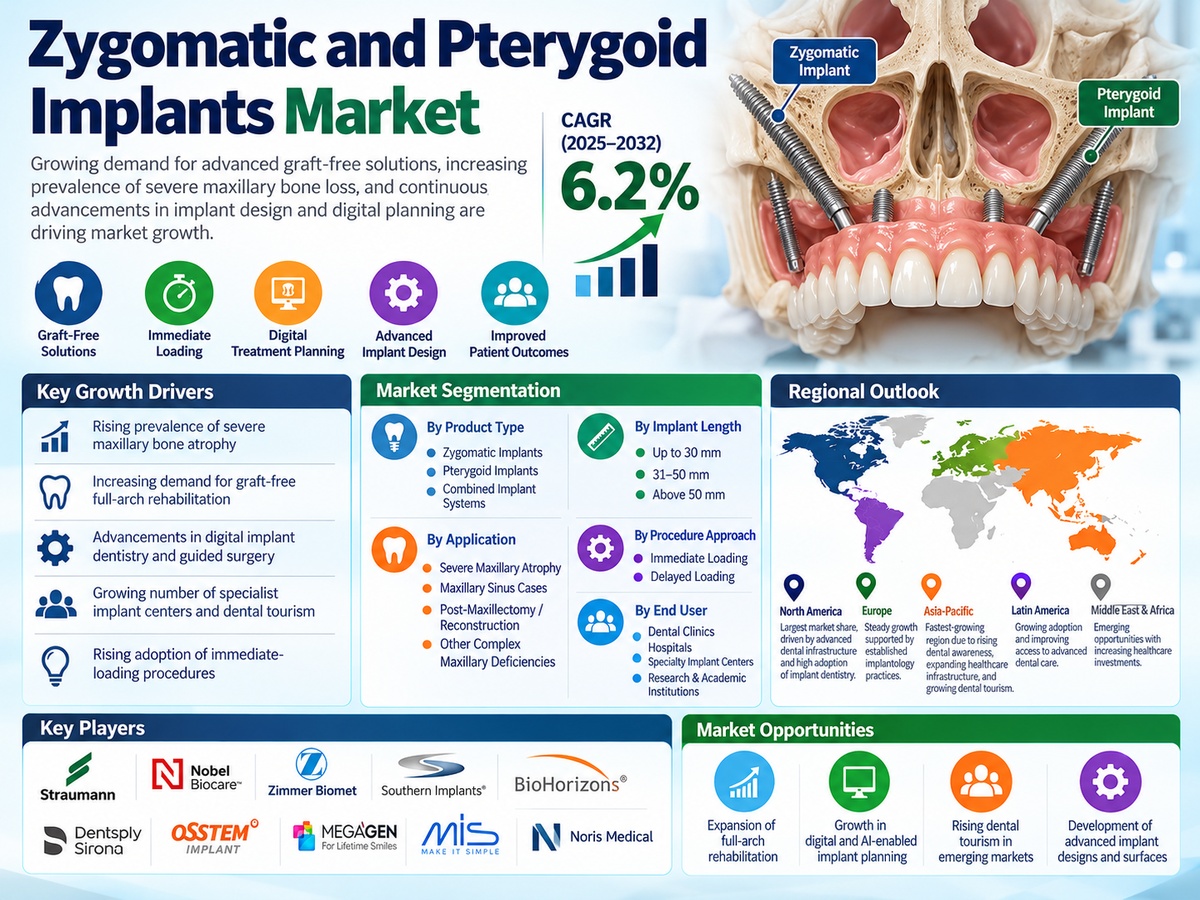
Increasing preference for graft-free treatment approaches is creating strong market opportunities.
Patients suffering from severe maxillary atrophy often require complex treatment planning because of insufficient bone volume in the upper jaw. Zygomatic and pterygoid implants provide alternative anchorage by utilizing stronger anatomical structures, helping clinicians reduce the need for major bone augmentation procedures in selected patients. This can support shorter treatment timelines, fewer surgical stages, and improved access to fixed full-arch restoration.
Technology development is also playing an important role in market growth. CBCT imaging, digital treatment planning, guided implant surgery, intraoral scanning, CAD/CAM prosthetics, and advanced implant surfaces are helping clinicians improve placement accuracy and overall treatment efficiency. These technologies are making complex implant procedures more predictable and supporting wider adoption among specialist dental centers.
Zygomatic implants remain a major product category because of their established use in severe maxillary bone-loss cases. Pterygoid implants are also gaining attention as an effective option for posterior anchorage in difficult maxillary conditions. In many advanced rehabilitation cases, clinicians are using a combination of conventional, zygomatic, and pterygoid implants to improve stability and support full-arch prosthetic solutions.
By application, severe maxillary atrophy continues to generate significant demand, along with maxillary sinus-related cases, complex maxillary deficiencies, reconstruction procedures, and full-arch rehabilitation. Immediate-loading techniques are also becoming more widely accepted as patients increasingly seek faster restoration and reduced treatment duration.
From a regional perspective, North America remains an important market due to strong dental infrastructure, high use of implant dentistry, and availability of experienced oral surgeons and implant specialists. Europe continues to benefit from established clinical practices and strong adoption of advanced dental technologies. Meanwhile, Asia-Pacific is showing strong growth potential, supported by rising dental awareness, improving healthcare access, higher disposable income, and increasing dental tourism.
The competitive environment is becoming more active as companies focus on specialized implant designs, digital workflow integration, clinician training, and advanced full-arch treatment solutions. Leading participants include Straumann Group, Nobel Biocare, Zimmer Biomet, Southern Implants, BioHorizons, Dentsply Sirona, Osstem Implant, Noris Medical, MegaGen Implant, and MIS Implants Technologies.
With continued innovation in implant dentistry and rising demand for complex maxillary rehabilitation, the Zygomatic and Pterygoid Implants Market is expected to create growing opportunities for dental implant manufacturers, specialist clinics, hospitals, and digital dentistry solution providers worldwide.