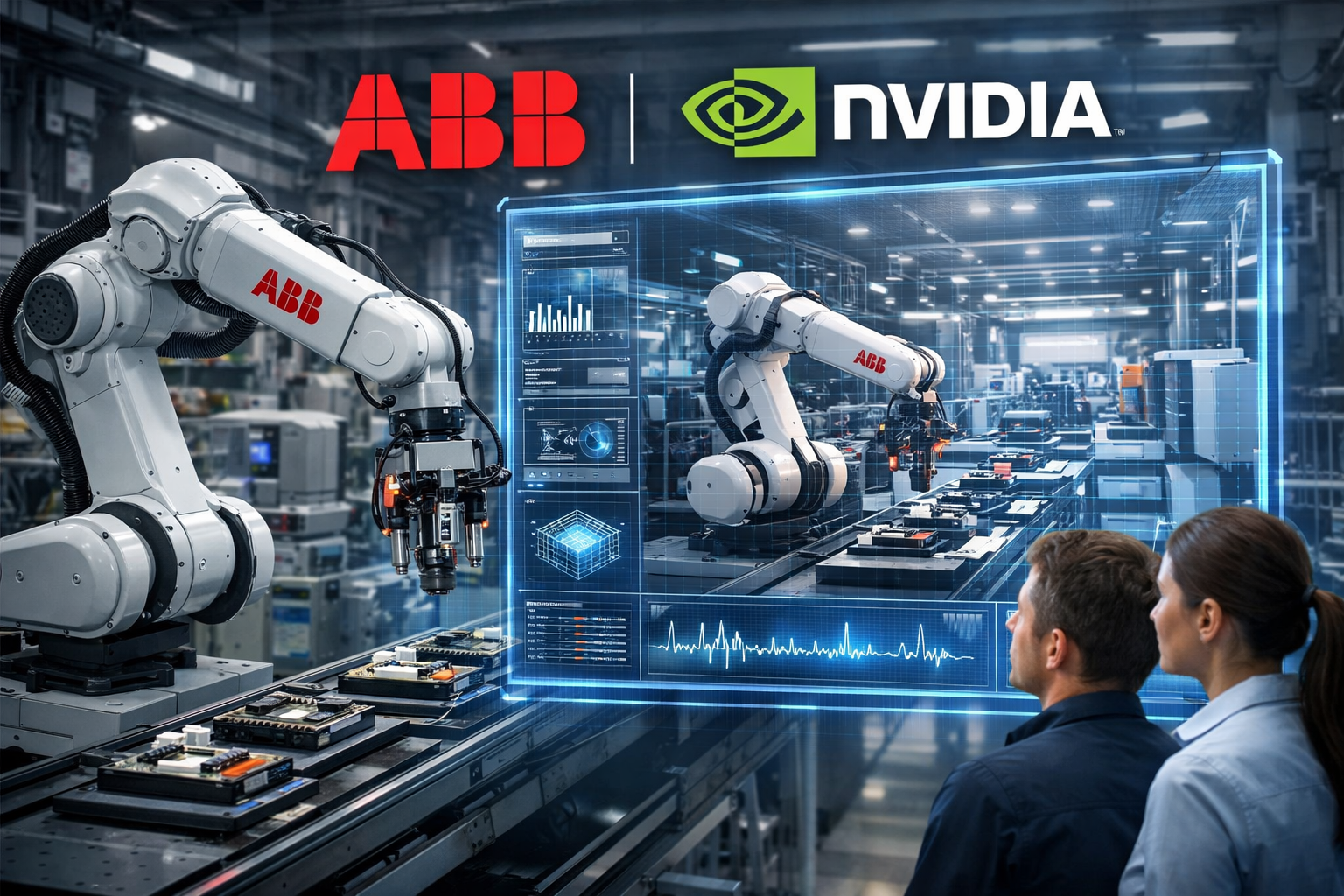
Global automation company ABB has announced a collaboration with NVIDIA aimed at improving the training and deployment of industrial robots used in modern manufacturing facilities. The partnership focuses on integrating advanced simulation technologies that allow robots to be trained in highly realistic virtual environments before being deployed on factory floors.
By combining ABB’s robotics expertise with NVIDIA’s advanced computing and simulation technologies, the companies aim to reduce the gap between virtual robot training and real-world industrial operations. This approach allows manufacturers to test and refine robotic processes digitally, improving performance and reliability before physical implementation.
One of the key challenges in robotics deployment is ensuring that robots trained in simulated environments perform effectively in real factory settings. Differences in lighting conditions, machine vibrations, object visibility, and environmental variability often reduce operational accuracy when robots move from simulation to production.
The new collaboration addresses this issue by enabling highly detailed digital simulations that replicate real manufacturing environments. Through these simulations, robots can learn how to adapt to various real-world factors, enabling more accurate and reliable performance once deployed.
The partnership will integrate NVIDIA’s simulation capabilities into ABB’s RobotStudio platform, a widely used software for programming and optimizing industrial robots. The enhanced system will allow engineers to create detailed digital models of manufacturing processes and train robots in these environments before physical deployment.
This approach is expected to significantly reduce robot commissioning time, lower operational costs, and accelerate production setup in manufacturing facilities. By improving the accuracy of robot training in virtual environments, companies can also minimize costly errors during the initial deployment stage.
The technology is already being tested in advanced manufacturing applications, including electronics assembly operations. In such environments, robots often perform highly precise tasks such as component placement or device assembly. Training robots through realistic digital simulations helps them better handle complex visual conditions, shadows, and object recognition challenges.
The collaboration highlights the growing importance of AI-powered simulation and digital twin technologies in the industrial sector. Digital twins enable manufacturers to create virtual replicas of factories, machines, and production processes, allowing them to test operations, optimize workflows, and train robots without disrupting real production lines.
As automation continues to expand across industries such as automotive, electronics, and industrial equipment manufacturing, partnerships like the one between ABB and NVIDIA are expected to accelerate the adoption of intelligent robotics and advanced manufacturing technologies worldwide.
The global consumer electronics landscape is undergoing a structural shift, driven by the convergence of…
Introduction to Transportation Biofuel Transportation biofuel refers to renewable fuels produced from biological resources such…
Rapid Growth of AI Projects on GitHub GitHub has become one of the most active…
Artificial Intelligence (AI) and advanced analytics are rapidly reshaping the global military and defense landscape.…
The automotive overhead console has evolved from a simple dome-light housing into a multifunctional control…
Artificial Intelligence (AI) and Machine Learning (ML) are becoming core technologies across industries. Organizations are…