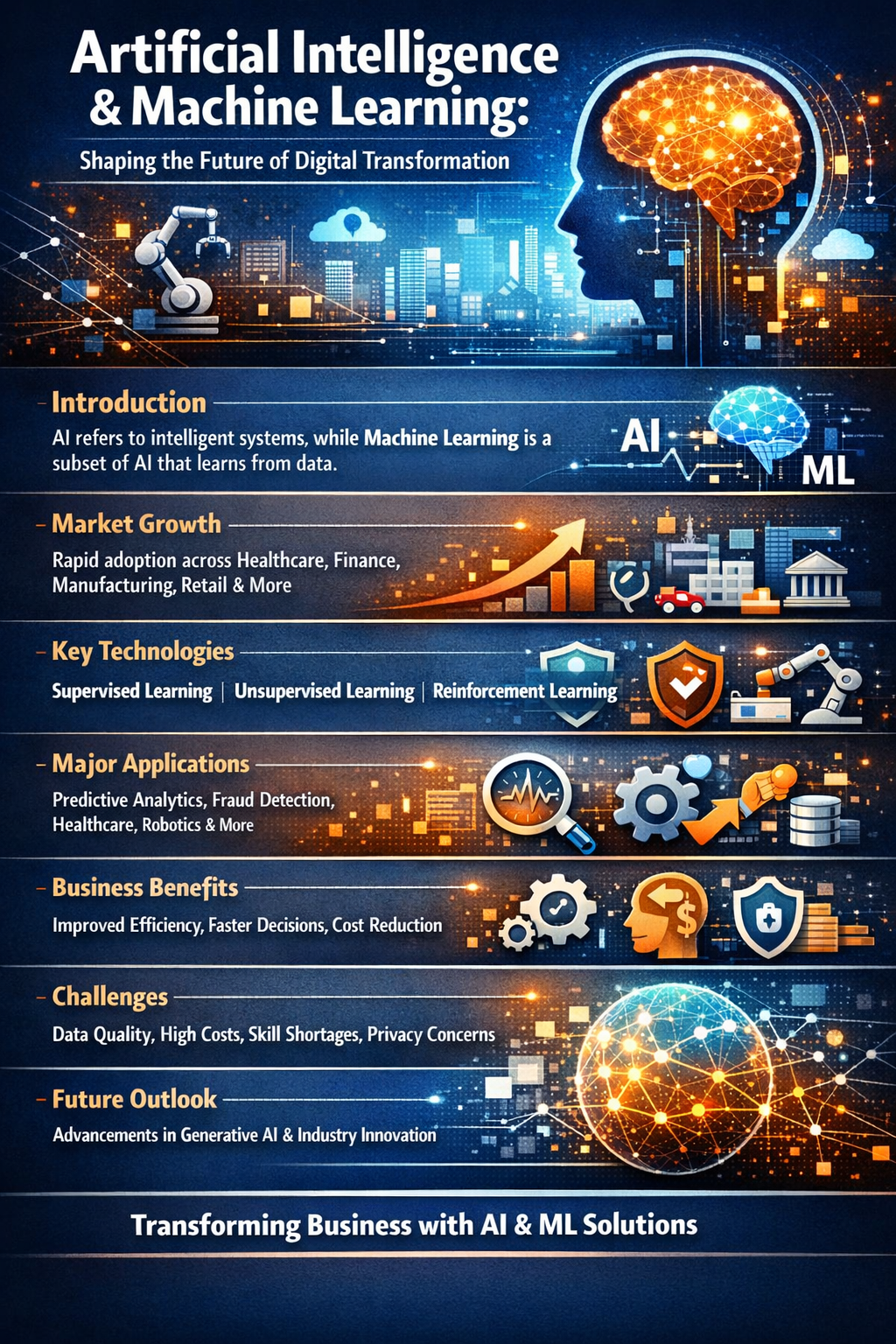
Artificial Intelligence (AI) and Machine Learning (ML) are becoming core technologies across industries. Organizations are using these technologies to improve efficiency, reduce costs, and make better decisions using data. AI refers to systems that can perform tasks requiring human-like intelligence, while ML is a subset of AI that enables systems to learn from data and improve performance over time without manual programming.
The adoption of AI and ML is increasing across sectors such as healthcare, manufacturing, finance, retail, logistics, and government services. Growth is driven by rising data volumes, improved computing power, and wider availability of cloud-based AI platforms. Enterprises are moving from pilot projects to large-scale deployment, indicating strong long-term market potential.
AI systems rely on algorithms, data, and computing infrastructure to perform tasks such as image recognition, speech processing, prediction, and automation. Machine Learning models use structured and unstructured data to identify patterns and generate insights. Common ML approaches include supervised learning, unsupervised learning, and reinforcement learning, each suited to different business use cases.
AI and ML are widely used in predictive analytics, fraud detection, recommendation engines, customer support automation, and quality inspection. In healthcare, they support diagnostics and drug discovery. In manufacturing, they enable predictive maintenance and process optimization. In finance, they improve risk assessment and compliance monitoring.
Organizations using AI and ML report improved operational efficiency, faster decision-making, and better customer experience. Automation of repetitive tasks reduces manual effort, while data-driven insights support strategic planning. These technologies also help companies scale operations without proportional increases in cost.
Despite strong growth, adoption faces challenges such as data quality issues, high initial investment, skill shortages, and concerns related to data privacy and model transparency. Businesses are increasingly focusing on responsible AI practices, governance frameworks, and workforce upskilling to address these issues.
AI and Machine Learning will continue to evolve with advances in generative AI, edge computing, and industry-specific models. As costs decline and tools become easier to deploy, adoption is expected to expand among small and mid-sized enterprises. Long-term growth will be supported by continuous innovation and increasing reliance on data-driven decision-making.
Artificial Intelligence and Machine Learning are no longer emerging technologies but essential components of modern digital strategy. Organizations that invest early and align AI initiatives with clear business goals are better positioned to gain competitive advantage in a data-driven economy.
As global air passenger traffic continues to rise, the importance of reliable and advanced Air…
In today's digital world, having a reliable laptop is essential for work, education, business, and…
Wooden furniture has remained one of the most preferred choices for homes, offices, hotels, and…
Wearable display technology is changing the way people interact with digital information. From smartwatches and…
As the world accelerates its transition toward renewable energy, solar power has emerged as one…
Hard Surface Flooring Market Gains Momentum Amid Rising Construction and Renovation Activities The global hard…