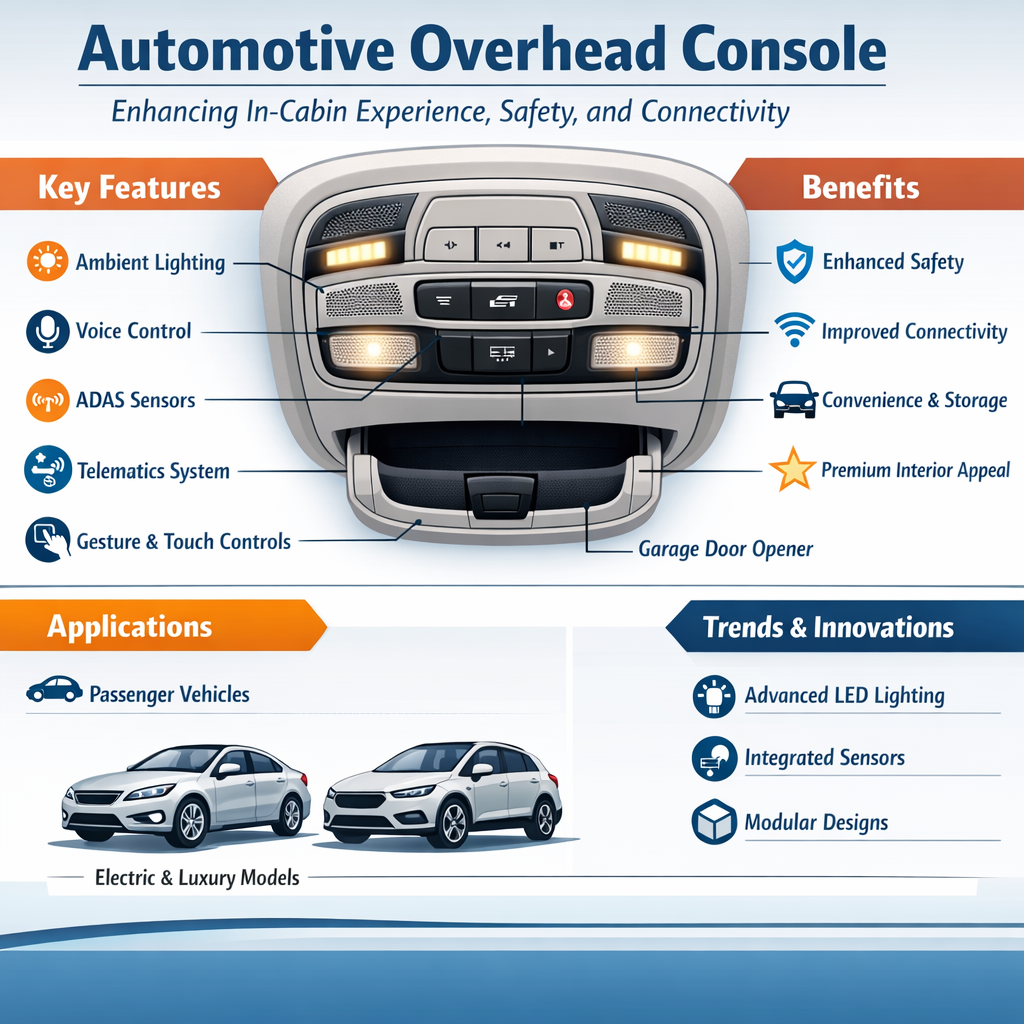
The automotive overhead console has evolved from a simple dome-light housing into a multifunctional control hub that enhances comfort, convenience, safety, and premium appeal inside modern vehicles. Positioned in the roof area between the driver and front passenger, this module integrates lighting, storage, electronic controls, sensors, and connectivity features into a compact assembly. As vehicles become more software-defined and feature-rich, the overhead console plays an increasingly important role in delivering value-added cabin functionality without occupying dashboard space.
Modern overhead consoles typically incorporate map lights, ambient lighting, sunroof controls, microphone arrays for voice assistants, emergency call (eCall) buttons, telematics interfaces, and sometimes advanced driver assistance system (ADAS) sensors. Many designs also include practical elements such as sunglasses holders, garage door transmitters, and rear climate controls. Premium vehicles may further integrate gesture sensors, touch panels, occupancy sensors, and configurable lighting systems, transforming the console into an interactive human–machine interface (HMI) node.
From a safety perspective, overhead consoles support emergency communication features and improved visibility through optimized lighting distribution. Integrated microphones enhance hands-free calling and voice recognition accuracy by being positioned closer to occupants’ heads. In vehicles equipped with sunroofs or panoramic roofs, the console serves as the primary control interface, enabling seamless operation while minimizing driver distraction.
Electrification and digitalization trends are accelerating innovation in this segment. Electric vehicles (EVs) and higher-trim models typically feature richer interior electronics content, which increases the complexity and value of overhead modules. Ambient lighting systems, energy-efficient LEDs, and lightweight materials help manufacturers meet both aesthetic and efficiency targets. Additionally, modular designs allow automakers to customize features across different vehicle segments while maintaining cost efficiency in production.
For OEMs and Tier-1 suppliers, overhead consoles represent an attractive opportunity to differentiate interiors and increase content per vehicle. Consumers increasingly associate advanced cabin features with vehicle quality and brand positioning, making this component strategically important in competitive automotive markets.
In summary, the automotive overhead console has transitioned from a basic lighting fixture to a smart, multifunctional cabin module that supports comfort, connectivity, safety, and premium design. As vehicles continue to integrate advanced electronics and user-centric features, demand for sophisticated overhead console systems is expected to remain strong across passenger cars, SUVs, and emerging electric platforms.
The global consumer electronics landscape is undergoing a structural shift, driven by the convergence of…
Introduction to Transportation Biofuel Transportation biofuel refers to renewable fuels produced from biological resources such…
Strategic Partnership to Enhance Robotics Simulation Global automation company ABB has announced a collaboration with…
Rapid Growth of AI Projects on GitHub GitHub has become one of the most active…
Artificial Intelligence (AI) and advanced analytics are rapidly reshaping the global military and defense landscape.…
Artificial Intelligence (AI) and Machine Learning (ML) are becoming core technologies across industries. Organizations are…