 Mobile Computing Today News from the Mobile World

The rapid growth of artificial intelligence across industries is creating unprecedented demand for advanced computing infrastructure, but AI hardware bottlenecks are emerging as a major challenge for enterprises, cloud providers, and semiconductor manufacturers worldwide. As organizations accelerate deployment of generative AI, large language models, autonomous systems, and AI-powered analytics, limitations in GPU availability, memory bandwidth, power consumption, semiconductor fabrication capacity, and data center infrastructure are increasingly affecting scalability and deployment timelines.
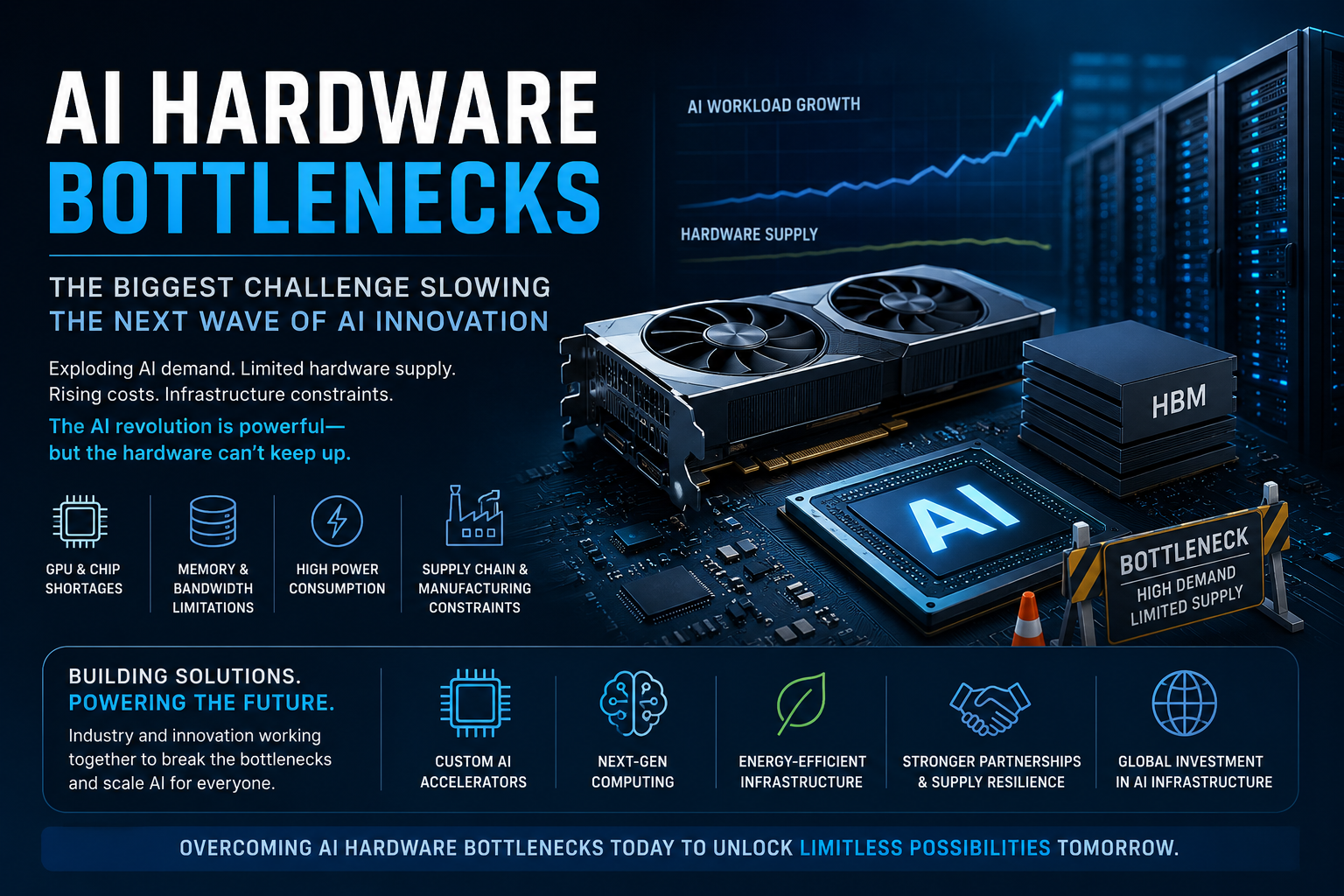
Industry analysts indicate that AI workloads are growing at a significantly faster pace than hardware supply capabilities. The increasing complexity of AI models requires high-performance GPUs, AI accelerators, high-bandwidth memory (HBM), advanced networking chips, and energy-efficient data center architectures. However, supply chain constraints, geopolitical tensions, and rising manufacturing costs continue to restrict the availability of advanced semiconductor components required for AI computing ecosystems.
The shortage of AI hardware is particularly impacting hyperscale cloud providers, enterprise AI developers, automotive AI systems, robotics manufacturers, and healthcare AI platforms. Organizations deploying large-scale AI models are facing increased operational costs due to limited chip availability and rising prices of advanced processors. In addition, long procurement cycles for GPUs and AI servers are delaying AI integration initiatives across multiple sectors including BFSI, manufacturing, retail, defense, and life sciences.
One of the key concerns in the industry is the concentration of advanced semiconductor manufacturing capabilities within a limited number of fabrication facilities globally. High-end AI chips require advanced process nodes, advanced packaging technologies, and sophisticated cooling systems, which are currently available only through a small group of semiconductor foundries. This concentration creates vulnerability in the global AI supply chain and increases dependency on a few manufacturing regions.
Energy consumption is another major issue associated with AI hardware expansion. Large AI models require substantial computational power, resulting in increased electricity demand and data center cooling requirements. Data center operators are increasingly investing in liquid cooling systems, advanced power management technologies, and energy-efficient AI processors to address sustainability concerns. However, infrastructure modernization requires significant capital investment, creating barriers for small and medium-sized enterprises seeking AI adoption.
The AI hardware bottleneck is also driving innovation in alternative computing technologies. Companies are investing heavily in custom AI accelerators, neuromorphic computing, photonic chips, edge AI processors, and next-generation semiconductor materials to improve computational efficiency and reduce dependency on traditional GPU architectures. Several technology firms are also expanding partnerships with semiconductor manufacturers to secure long-term chip supply agreements and strengthen production resilience.
North America continues to lead the global AI infrastructure landscape due to strong investments in cloud computing, semiconductor R&D, and hyperscale data centers. Meanwhile, Asia Pacific is witnessing rapid growth in semiconductor manufacturing expansion initiatives, particularly in countries such as China, South Korea, Taiwan, and Japan. Europe is also increasing investments in AI sovereignty programs and domestic chip manufacturing capabilities to reduce external dependencies.
Major technology companies including NVIDIA, Advanced Micro Devices, Intel, Taiwan Semiconductor Manufacturing Company, Samsung Electronics, Google, Microsoft, and Amazon Web Services are increasing investments in AI-focused hardware ecosystems, custom chip development, and data center optimization strategies to address growing computational demand.
Despite ongoing challenges, the long-term outlook for AI infrastructure remains highly positive as governments and private organizations continue prioritizing digital transformation and AI innovation. Industry participants expect sustained investments in semiconductor fabrication, AI accelerator technologies, advanced packaging, and energy-efficient computing architectures to gradually reduce hardware bottlenecks and support the next phase of global AI adoption.
